

How To Draw An Arrowhead In Photoshop
Here are my favorite tips, tricks and shortcuts for working with the Shape Tools in Photoshop.
This quick tip (Ten Tips and Shortcuts for the Shape Tools in Photoshop), shows several of my favorite tips for working with the Shape tools in Photoshop.
This quick tip (How to Capture Patterns, Shapes, Colors and Gradients From Images in Photoshop) demonstrates the new Capture from Image functionality in Photoshop, that automatically create patterns, shapes, color themes, and gradients from your images.
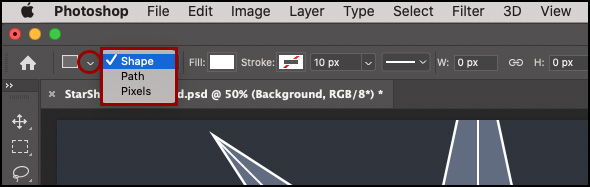
Prior to Drawing Shapes—Before starting to work with any of the Shape tools, be sure to use the drop down carte du jour in the Options bar to choose between creating a Shape Layer, Path, or Filled Pixel regions or yous might accept to backtrack or go through extra steps to right it.Notation: other options (such as irresolute fill up and stroke attributes), are easily changed/refined later on cartoon the shape using the Backdrop panel.
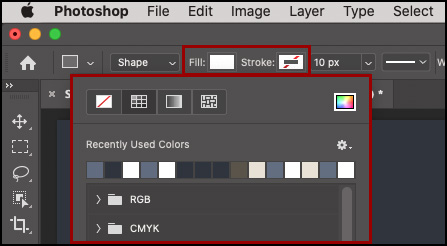
•Click the Make full and Stroke color swatches to choose the type of content: None (for a transparent shape), Solid Color, Slope, or Pattern. Or, click the Colour swatch to choose a colour from the color picker or from recently used colors.
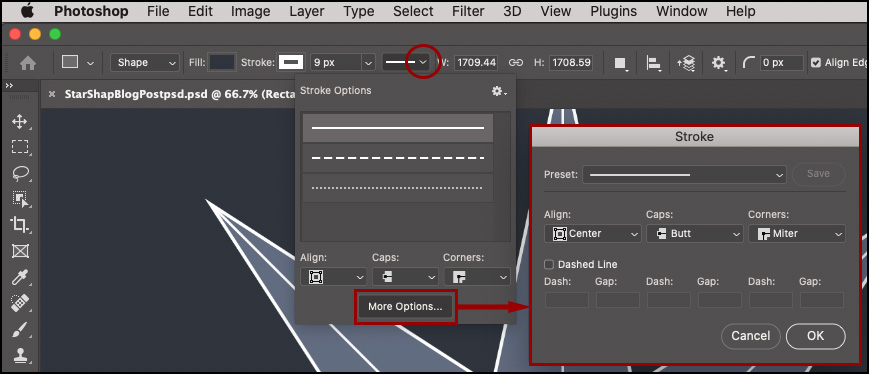
• When adding strokes to a shape, click the downward pointing chevron to modify Align, Caps, and Corners options. Click the More Options… button to enter Gap and Dash values (to create dashed lines) and use the Presets drop down carte du jour to save custom presets.
• To salve all of the Options for a shape tool (fill, stroke, size etc.), create a Tool Preset. Click here for more information to Tool Presets.
• Use the post-obit shortcuts to quickly change Shape values in the Options bar:
The Rectangle Tool: '[' or ']' decreases or increases the corner radius by one pixel. Add the Shift key to increase/decrease the radius in increments of 10.
The Polygon tool: '[' or ]' decreases or increases the number of sides by ane. Add together the Shift key to increase/decrease the number of sides in increments of 10.
The Line tool: '[' or ']' decreases or increases the line Weight value past one pixel. Add together the Shift central to increase/decrease the line width in increments of 10.
Or, instead of using the Options bar to change setting specific to each Shape, unmarried click with the shape tool in the image area and prepare the desired options in the Create (Shape) dialog. 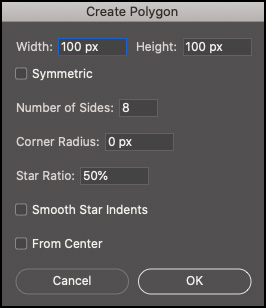
While Drawing Shapes —When drawing shapes, utilize the gear icon in the Options bar to alter default behaviors or, use the following shortcuts:
• Add the Shift cardinal to constrain proportions while cartoon shapes (constrain proportions is off by default).
• Selection -drag (Mac) | Alt -drag (Win) to draw the shape from the middle.
• Press the Spacebar to reposition the shape while cartoon.
• Command -elevate (Mac) | Control -drag (Win) to alter the angle (rotate) of a Polygon while drawing.
On-Screen Transform Controls — Subsequently cartoon shapes, Photoshop displays on-screen transform controls:
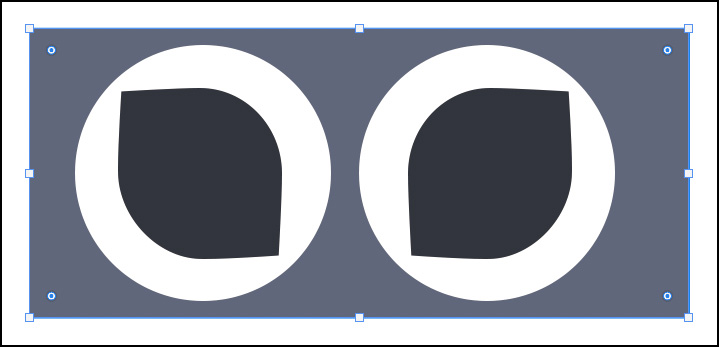
• Drag any control betoken to calibration the shape. Constrain proportions is off by default. Add the Shift cardinal to constrain proportions.
• Position the cursor outside of a command indicate (the icon will change to a double headed arrow) to rotate. To reset a rotation, utilize the Properties panel. Note: to change the signal from which shapes are scaled and rotated see "Reference Point" below.
• Elevate the Corner Radius control betoken to increase/decrease the radius of the shape. By default the corner radii are linked: Option -drag (Mac) | Alt -drag (Win) to change a unmarried corner radius. Note: the Triangle and Polygon tools accept a unmarried Corner Radius control point handle which modifies the roundness of all corners as. There are no individual Corner Radius control points for the triangle tool at this time.
• When multiple shapes are selected on a single layer, changing the attributes for 1 shape volition change all selected shapes.
Note: To use transformations such as Skew, Misconstrue, Perspective, and Warp, select Edit > Transform Path still this will convert the Live Shape Properties to a regular shape.
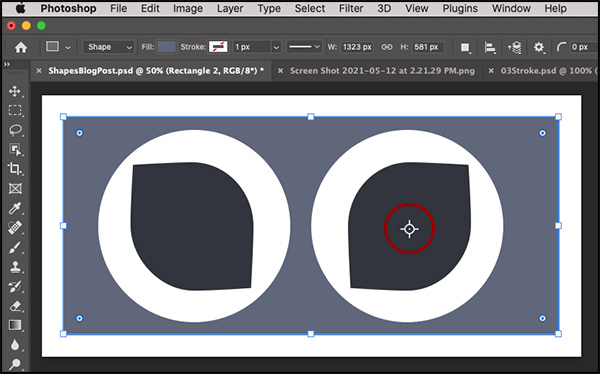
Reference Point—To change the Reference point for Shape layers (the Reference point is the point from which shapes are scaled and rotated using on-canvas transform controls), select Preferences > Tools > Show Reference Point when Using Transform.
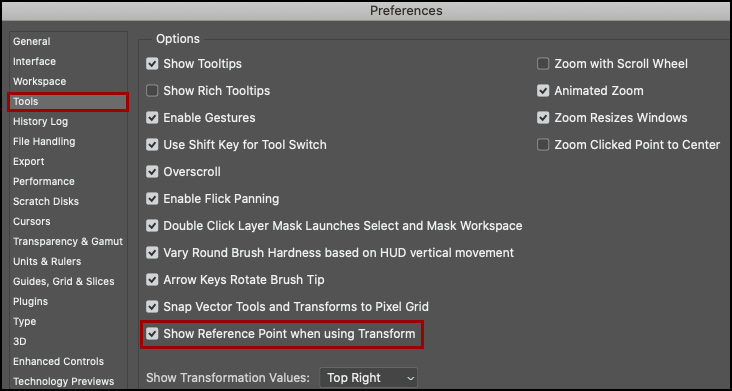
Or, cull Edit > Free Transform and check the empty well to the left of the reference point icon in the Options bar to enable information technology. To reposition the Reference Point, drag the eye point icon within the image area.
The Properties Panel—Later drawing a shape, use the Backdrop panel to modify a shape's attributes such as: flip, angle/rotation, radius, number of sides and star attributes (indent pct and smooth radius) and Pathfinder commands.
• To view changes made using the Properties panel in real time, instead of entering values into the text boxes (which crave borer Enter or Return to preview changes), use Photoshop's Scrubby sliders (position the cursor over the proper name of the feature: when the cursor changes to paw with arrows pointing in both directions, click-drag left/correct to decrease/increase values). Option -dragging (Mac) | Alt -dragging (Win) increases/decreases the values more slowly while Shift -dragging decreases/increases the values more than quickly.
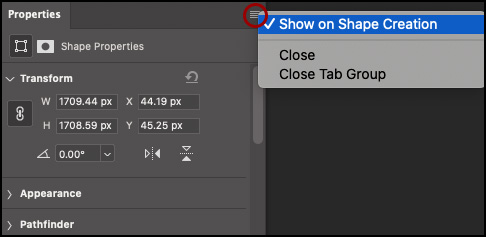
Preventing the Backdrop Console from Motorcar-Expanding when Drawing Shapes — When the Properties panel is collapsed to "icon" view, adding a shape automatically expands the panel (making information technology easier to access Shape Properties). To prevent the Properties panel from automatically expanding, from the Properties console's fly-out card, uncheck "Bear witness on Shape Creation". Note: y'all must take a Shape layer with Live Shape Properties to access this fly-out menu.
Changing a Shape's Colour using the Layers Panel — Double click the Shape Layer'due south thumbnail to change the color of the shape's make full. The benefit of using this method is that the shape'south color is updated in real fourth dimension (unlike using the color swatch in the Properties panel where you lot have to commit to the color before seeing the modify in the image area).
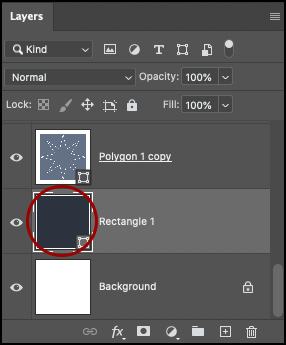
Applying Presets to Shapes —This post (Preset Console Behaviors in Photoshop 2020 v21), reveals everything you need to know about applying Swatches, Gradients, Patterns, and Styles to shapes.
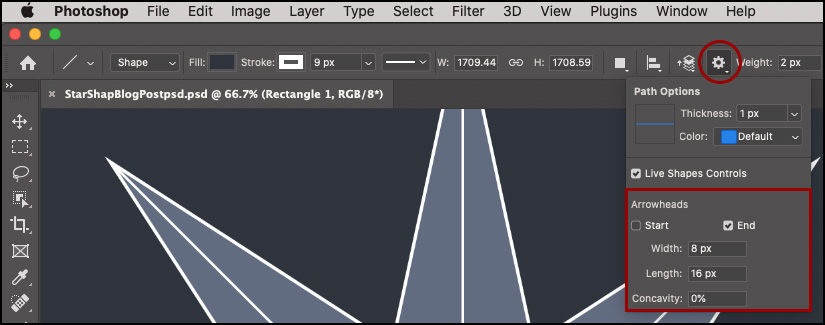
Adding Arrowheads to a Line — Click the Gear icon in the Options bar to add and customize the width, length and concavity of the arrowhead(s). Annotation: Arrowheads demand to be added to lines earlier they are drawn.
Selecting Shape and Shape Layers — With the Path Choice or Direct Choice tool selected, targeting a Shape Layer in the Layers panel automatically displays the shape'south path in the image area (making it easier to rapidly edit the shape).
• Clicking on a shape in the image expanse with the Path Choice tool will automatically select that layer in the Layers panel. Shift -click on another shape to add information technology to your selection. Shift -click on a selected shape to deselect it.
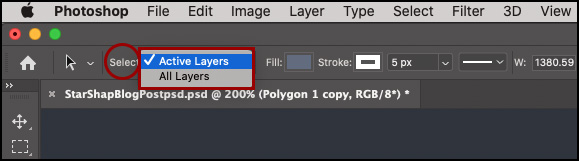
• Use the Path Selection tool to drag-select shapes in the image expanse. Use the Direct Selection tool to drag-select portions of a shape/path(southward). To isolate the option to only the currently selected Layer (or layers), fix the Selection selection (in the Options bar) to Active Layers. To drag-select shapes from multiple layers, set the Select option to All Layers.
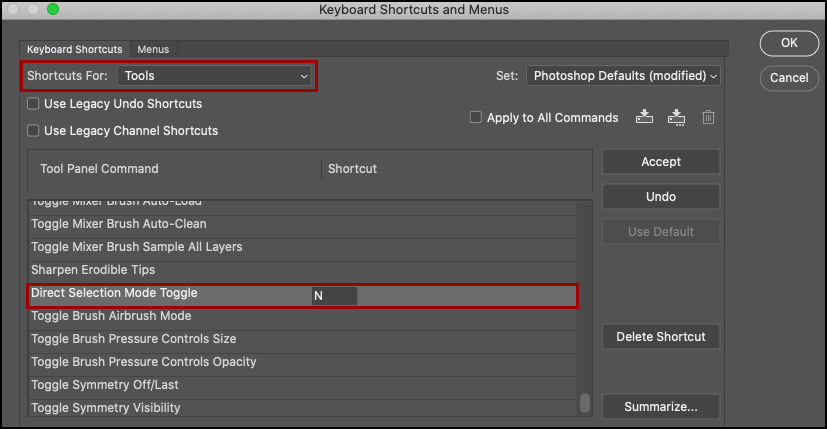
• To assign a custom Keyboard shortcut to toggle between selecting the Active Layers and All Layers, choose Edit > Keyboard Shortcuts and set Shortcuts For: Tools. Whorl down and enter a single grapheme for Straight Selection Manner Toggle.
Re-create and Paste Make full and Stroke Attributes — To copy and paste Fill or Stroke attributes from one shape to another, correct -click ( or Control -click Mac) on the Layers panel (to the correct of the layer name), and select Re-create Shape Attributes. And so, in the Layers console, select the layer(southward) to paste the attributes and right -click (or Control -click Mac) and select Paste Shape Attributes.
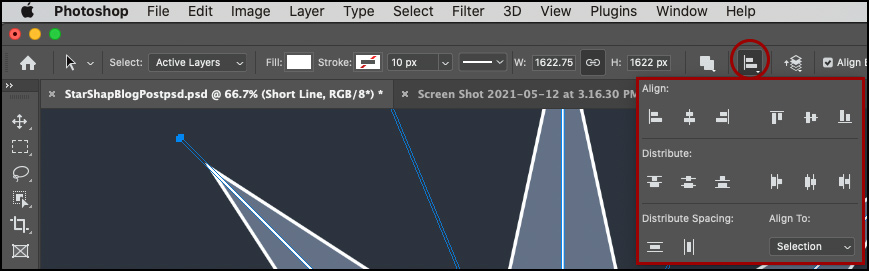
Align and Distribute Shapes — With multiple shapes selected on the aforementioned layer, employ the Path Alignment icon in the Options bar to marshal the selected shapes (to the Option or Canvass) and/or distribute the shapes (based on the size of the shape or the spacing between shapes).
Hiding a Shape Layer'southward Path —Command + H (Mac) | Control + H (Win) hides the Shape Layer's path. Notation: The first time yous use this shortcut (Control + H) on the Mac OS, Photoshop will display a dialog asking "Would you lot like to use Control + H to hibernate Photoshop (Mac standard), or to hide/testify selections, guides, etc. (Photoshop traditional)?" Click "Hide Extras" unless you want to "Hide Photoshop" every time you use the shortcut. If you do cull to "Hide Photoshop", you tin can change this behavior afterwards by choosing Edit >Keyboard Shortcuts. Set Shortcuts For: Application Menus and toggle the disclosure triangle for the View carte. Whorl down to Extras, change the Shortcut back to Command + H and click Take and and so OK.
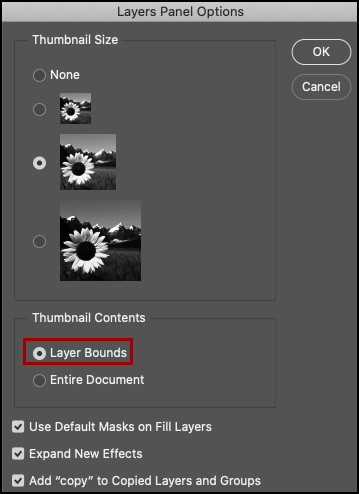
Viewing Shape Layers in the Layers Panel — When working with complex documents that contain several small shape layers, changing the Thumbnail Contents from Entire Certificate to Layer Bounds can make information technology easier to see the contents of a layer. From the Layer'south panel fly-out, choose Console Options… and select Layer Bounds (Layer Premises typically provides larger previews of layers containing minimal content whereas equally the Entire Certificate option volition brandish the content smaller; in human relationship to the unabridged document).
Converting Shapes to Smart Objects — To prevent to conversion of a shape with Alive Shape Properties to a regular shape, first convert the shape into a Smart Object, then employ the transformation. And, if you first create a Shape Layer and convert information technology to a Smart Object and then indistinguishable the Smart Object, when you edit the contents of the Smart Object (to change the color or corner radius of the shape for example), all instances of that Smart Object will be updated. This video demonstrates how (the instance begins at 8:thirty).
Applying Path Functioning Shortcuts —By default, the shape tools describe a new Shape Layer every time you click and elevate with the tool. Utilize the Path Operations drop-down list in the Options bar in guild to add boosted shapes to a single Shape Layer or utilize the post-obit shortcuts:
• After starting to describe a second shape (but before releasing the cursor), holding the Shift fundamental adds the newly fatigued shape to the current shape layer and combines the 2 shapes if the ii paths overlap (Combine Shapes).
• Belongings the Option (Mac) | Alt (Win) and dragging a shape adds a newly drawn shape to the current shape layer and subtracts the new path from the previous shape(s) if the 2 shapes overlap (Subtract Front end Shape). Notation: after you start drawing the shape, you can release the shortcut keyboard modifierto elevate the shape from the corner instead of the center.
• Holding the Selection + Shift (Mac) | Alt + Shift (Win) and dragging a shape adds a newly drawn shape to the current shape layer and displays the intersection of the shapesif the two paths overlap (Intersect Shape Areas).Note: afterward you beginning cartoon the shape, you can release the shortcut keyboard modifiers.
To apply path operations to shapes after they are created, select the desired shapes (on a single layer) and use the following shortcuts:
• Tap the + (plus) primal to Combine Shapes (set the path performance in the Option bar to Combine Shapes).
• Tap the – (minus) key to Subtract the front shape (set the path operation in the Option bar to Subtract Front Shape).
• Tap the / (Forward Slash) key to set the path operation to Intersect Shape Areas.
• Tap the * (multiply) fundamental to set the path operation to Exclude Overlapping Shapes. Note: this shortcut requires input from an extended keyboard (shift + 8 does non work).

Above are examples of: Combine Shapes, Subtract Front Shape, Intersect Shape Areas and Exclude Overlapping Shapes.
Path System — The arrangement of shape/paths (sometimes referred to as their stacking order), every bit well equally path selection is disquisitional when assigning path operations. In the analogy beneath, the the circles in the first group were fatigued from left to right, on a single shape layer with the path operation ready to Combine Shapes. In the 2d group, the centre circle was selected and the path operation was changed to Exclude Overlapping Shape. Because path operations only affect paths below the selected path, merely the commencement circle was afflicted. In the last grouping, the center circle was selected and the Path Operation was also fix to Exclude Overlapping Shapes. However, when the center circle's system (stacking order) was set to the top of the stack (by selecting Bring Shape to Forepart using the Path Arrangement icon in the options bar) , information technology then affects both of the circles beneath information technology.
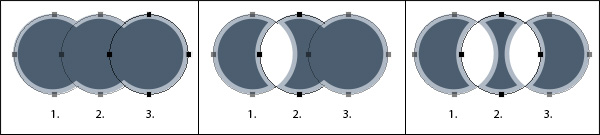
The analogy below is my attempt to show the stacking order of the paths in the above illustrations from a "side" view (nevertheless all 3 circles/paths/shapes are on a unmarried layer).

Fill and Stroke attributes — All shapes on a single Shape Layer volition take the same Fill and Stroke attributes. To use different attributes to shapes, put each shape on its own layer past selecting the shape and choosing Layer > New > Shape Layer Via Cut. Or, use the shortcut: Command + Shift + J (Mac) | Control + Shift + J (Win).
Pasting Shapes From Illustrator —If yous copy and paste a shape from Illustrator to Photoshop, the results volition differ depending on the type of layer selected:
• If a pixel layer is the selected layer in Photoshop, the pasted shape will take on the fill of the foreground color swatch ready in the Tool bar.
• If a shape layer is the selected layer in Photoshop, the pasted shape will have on the fill up from the Options bar.
Saving Custom Shapes —To save a shape for reuse at a subsequently time, select the shape and Choose Edit > Define Custom Shape to add the shape to your Shapes panel.
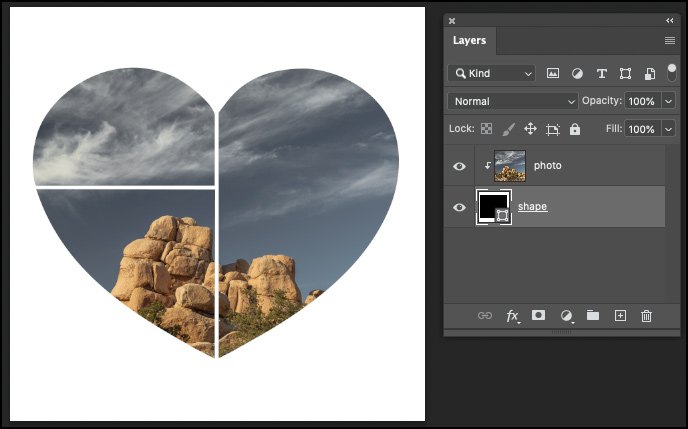
Displaying a Photograph within a Shape or Path — At that place are several ways to display a photo within a shape or path in Photoshop.
• This first example uses a Vector Mask to control what portion of the photo is hidden or revealed. To create this upshot, select the desired Shape tool and set the shape options (in the Options bar) to create a Path. Drag out the shape (with the photo layer selected) and then, choose Layer > Vector Mask > Electric current Path.
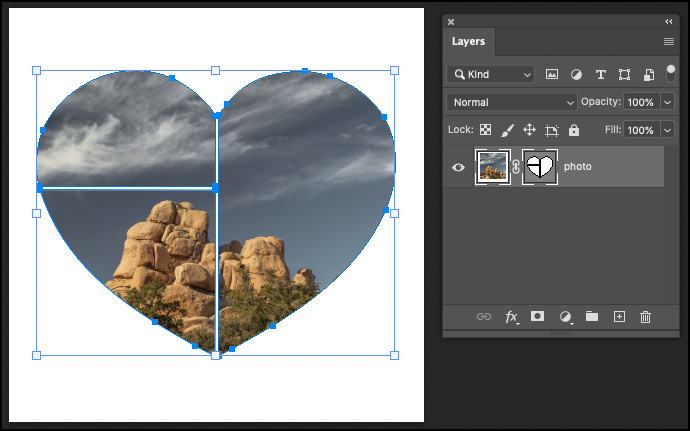
• The 2nd instance shows the photo clipped to a shape layer. To create this outcome, select the desired shape tool and fix the Shape tool options (in the Options bar) to draw a Shape. Elevate out the shape, then reposition the Shape Layer in the Layers console and so that the shape is below the layer with the photo. With the photo layer targeted (selected), choose Layer > Create Clipping Mask.
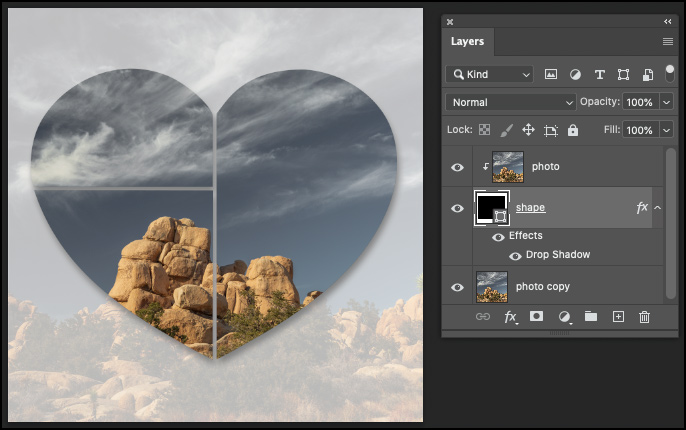
• The 3rd example shows a copy of the photo layer (photo re-create) beneath the shape layer. The photo copy layer has information technology'south opacity reduced and the shape layer has a drib shadow practical to create an interesting result.
 This quick tip (Masking Images to Shapes and Type) demonstrates how to apply a clipping mask to a Layer Group to display a photograph within type and shapes (while keeping both the type and graphics also equally the photograph re-editable).
Create New Guides from Shape — To create new guides based on the bounding box effectually a Shape Layer, select the Shape layer and choose View > New Guides From Shape.Note: you tin too create guides around Type layers and pixel based layers.
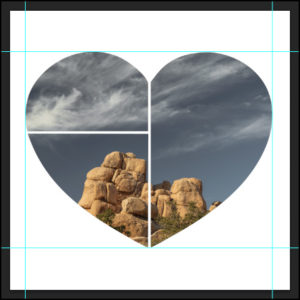
Guides created from the Shape Layer.
Snap Vector Tools and Transforms to Pixel Grid — If you Zoom into an image in a higher place 500%, a Pixel Grid is automatically displayed on pinnacle of the image. By default, Photoshop "snaps" shapes drawn with the Shape tools (as well equally shapes drawn with the pen tools) to the Pixel Grid. This prevents the creation of soft, anti-aliased edges on shapes such as rectangles and tin help when precise alignment of shapes is required. Note: If you need to disable the "snapping" behavior for whatsoever reason, choose Preferences > Tools > Snap Vector Tools and Transforms to Pixel Grid and uncles the preference. To toggle the Pixel Filigree off, uncheck Pixel View under View > Show >Pixel Grid.
The illustration below demonstrates three options for shape alignment:
• The first shape was fatigued with the Snap Vector Tools and Transforms to Pixel Grid preference enabled. As a outcome, all sides of the rectangle are solid. Note: even though the initial rectangle shape might not have been fatigued in perfect alignment to the pixel grid, Photoshop automatically snapped the rectangle shape to that grid considering the preference was enabled.
• The heart illustration was drawn with the Snap Vector Tools and Transforms to Pixel Grid preference disabled. This resulted in anti-aliased edges (varying levels of opacity) because the rectangle shape was not perfectly aligned to a pixel border when the rectangle was drawn.
• The final illustration is the same rectangle as in the 2d illustration (the Snap Vector Tools and Transforms to Pixel Grid preference was disabled), however the Align Edges option (in the Options bar) was enabled for the rectangle shape layer. Enabling the Align Edges selection "jumped" the fill of the rectangle to the nearest pixel grid (y'all tin still meet that the original shape (the blackness path), is not aligned to the pixel grid, just the fill is being forced to Align Edges to the edges of the pixel filigree). The Marshal Border choice is a convenient manner to align objects to the pixel grid on a "per shape layer" basis if y'all need to disable the Snap Vector Tools and Transforms to Pixel Grid preference for some reason.

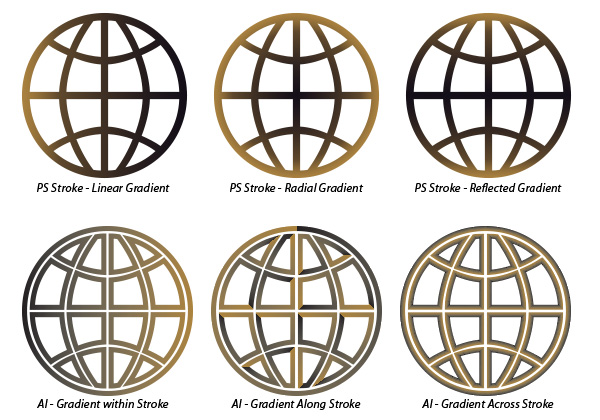
Adding a Slope Stroke on a Shape Layer — When adding a Slope stroke to a shape layer, Photoshop but draws a gradient and and then displays it inside the width of the stroke. You tin can change the look of the gradient by changing the style (Linear, Radial etc,), but if you want a gradient to be applied either forth a stroke or beyond a stroke, then you might want to step into Illustrator. The following graphic shows the unlike ways that Photoshop and Illustrator can apply strokes to shapes.
This video (New Features and Enhancements to Shape layers in Photoshop CS6) is besides quite useful if you prefer to meet a video of several of the tips mentioned to a higher place).
Copyright © 2022 Julieanne Kost.
All rights reserved.

How To Draw An Arrowhead In Photoshop,
Source: https://jkost.com/blog/2021/07/working-with-the-shape-tools-in-photoshop.html
Posted by: smithpere1940.blogspot.com
0 Response to "How To Draw An Arrowhead In Photoshop"
Post a Comment